Shopping Cart (0)
Close


No products in the cart.
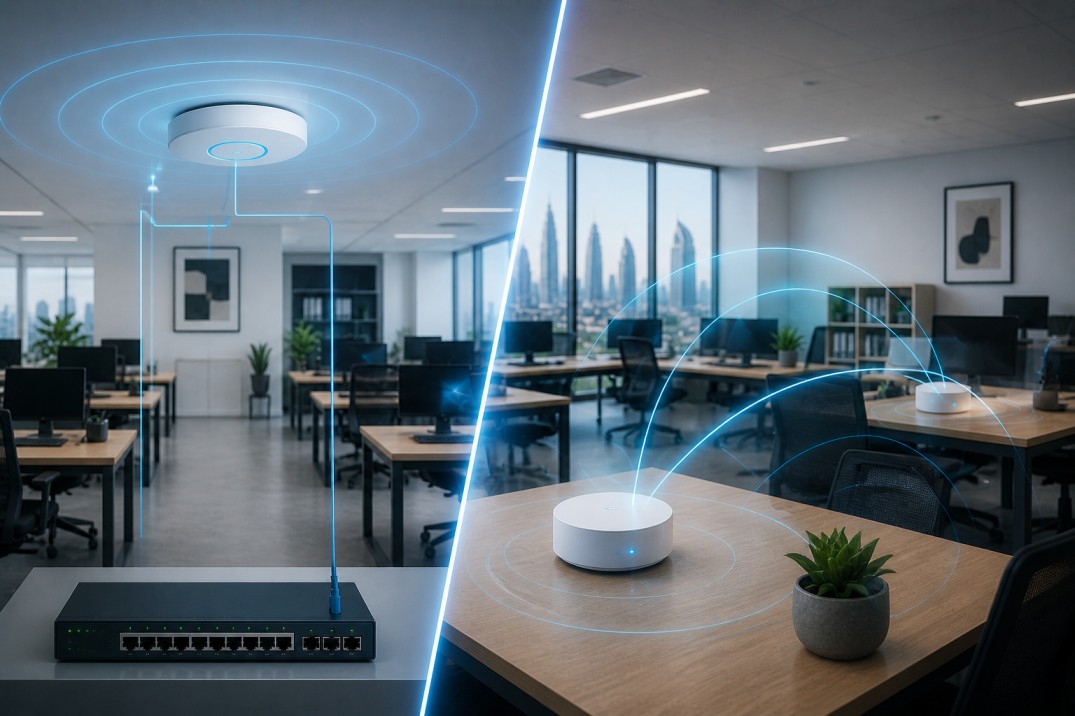
WiFi configuration is often considered more critical than what people might think at first glance. A lagging or unstable connection could slow down office operations, postpone deadlines, disrupt meetings, and make staff annoyed. For many businesses, the dilemma comes down to deciding on access points vs mesh WiFi.
Access points and mesh WiFi can both enhance wireless networking capabilities. However, their design and functionality are aimed at specific environments, which can differ substantially from small offices to rapidly developing businesses and expansive multilevel office spaces. Therefore, the best WiFi option will depend on the architectural design of the office space and the number of users who will be accessing the system.
In this guide, we will explain the difference between access points and mesh WiFi in simple terms. We will also help you understand which one is better for office spaces and why.
An access point is a device that connects to your main network through an Ethernet cable and then broadcasts WiFi to a specific area.In office settings, access points tend to be mounted on ceilings and walls in order to achieve reliable wireless coverage.
Access points are commonly used in the business setting owing to their ability to accommodate multiple users simultaneously, whereas home grade WiFi equipment cannot guarantee the same level of reliability.
Since they are wired to the network, they do not depend on wireless signals to communicate with each other.
This makes them a strong option for offices where speed, reliability, and scalability matter.
Mesh WiFi utilizes a router along with one or several satellites that cover an area by connecting to each other using wireless connection or Ethernet, based on the system.
There are plenty of advantages of using a mesh system. First, this type is user friendly and can solve problems of dead spots in households or small offices. Another advantage is that it creates just one network that works seamlessly with all devices.
For a small office with light usage, mesh WiFi can be a convenient solution. But it may not always be the best choice for a business that depends on heavy traffic, online meetings, cloud tools, and multiple connected devices.
The key distinguishing factor between access points and mesh WiFi technology lies in their method of communication.
Access points are wired to the network and thus provide greater speed and reliability. Conversely, mesh WiFi technology depends on wireless communication between nodes, an approach that can be detrimental to performance, particularly when several devices are added.
In short:
Access points work best where performance and reliable connection is paramount.
On the other hand, mesh WiFi technology works better in cases where there is a need for easy installation and smaller coverage areas.
An office does not function like a domestic space. Domestic WiFi configurations typically cater to only a few people, a couple of devices, and relatively low network traffic. In an office, there can be many people accessing the network simultaneously, along with computers, printers, telephones, video surveillance cameras, meeting room devices, and smart systems.
This puts a heavy load on the network.
In addition, an office needs:
stable video conferences
fast uploading and downloading of files
cloud application access
secure connection for devices
multi room/floor coverage
These requirements make it difficult for conventional WiFi configurations to operate effectively.This is where the choice between access points and mesh WiFi becomes important.
If you are planning your overall infrastructure, it’s also useful to understand server requirements. Read our guide on How to Choose the Right Server for Your Business in Dubai
Access points are usually the better option for offices in the following cases.
Access points are superior when there are multiple users are online at the same time because of their ability to cope with the heavy workload.
A bigger office will require multiple sources of wireless connectivity to ensure coverage throughout the premises. Access points can be distributed in various places in an office, which are then wired together.
Since access points are wired, they are less affected by signal loss between units. This gives better speed and consistency, especially in busy work environments.
Access points are easier to design around when setting up a structured office network. An IT team or network installer can place them based on floor plan, usage zones, and user density.
It will be easier to scale up the number of access points in the event of expansion of the company.
Mesh WiFi is not bad. In fact, it can be useful in certain office situations.
If your office is compact and has only a few users, a mesh system may be enough.
For popup offices, small studios, or temporary setups, mesh WiFi can be convenient because it is simple to install.
If running Ethernet cables is difficult or expensive, mesh WiFi can be a practical alternative.
If your team mainly uses email, browsing, cloud documents, and light communication tools, mesh WiFi may meet your needs.
Even then, the system should be chosen carefully. Not all mesh systems are built for business traffic, so performance can vary.
Let us compare them in the areas that matter most to office users.
Access points generally offer better speed because they are connected through cables. Mesh WiFi may lose some speed as the signal travels between units.
Access points are more stable, especially when many people are connected at once. Mesh systems can be more vulnerable to interference, especially in crowded office environments.
Both can cover a large area, but access points usually do it more reliably in offices with walls, floors, and heavy use.
Access points are easier to scale for growing businesses. Mesh systems can expand too, but performance may drop as more units are added.
Mesh WiFi is easier and faster to set up. Access points usually require more planning and cabling.
Mesh systems may appear cheaper at first. But for business use, access points often provide better value over time because they handle more users and last longer in demanding environments.
If your office setup includes storage heavy tasks, you should also check our comparison on SSD vs HDD for Business
Access points will always be better in offices compared to mesh Wi-Fi.
This is because an office requires more than just coverage; it needs performance. This includes stability, speed, security, and scalability. Access points are designed to offer this kind of performance.
Mesh Wi-Fi will suit you if you have a smaller office, little budget, or want a faster installation process. However, if you are trying to build a professional environment, it’s recommended that you use access points.
Choose mesh WiFi if:
your office is very small
you have a limited budget
you need a quick setup
your internet usage is light
Choose access points if:
your office has many users
your work depends on reliable internet
you need strong coverage across a larger area
you want a setup that can grow with your business
Most office owners tend to make their selection according to price. As a result, they face problems.
One common mistake is buying a home mesh system for a busy office. While it will function normally in the beginning, it can be overwhelmed with the number of devices.
Another thing to avoid is installing just one access point, believing it is enough to cover the entire area. The matter is that even a good device cannot cover everything.
Finally, companies usually neglect layout design. Walls, partitions, meeting rooms, and furniture affect wireless coverage.
Before choosing between access points and mesh WiFi, think about these points.
How many people will connect at the same time?
Is your office one room, one floor, or multiple floors?
Do you use cloud apps, video calls, large files, or business systems?
Are there walls or barriers that may weaken WiFi signals?
Will your team grow in the next year or two?
When you answer these questions, the right solution becomes much clearer.
Access points are the right option when you need to create an office network that is dependable in performance, stability, and scalability. Mesh WiFi is simpler to deploy and may suit small businesses with lower expectations.
In any case, mesh WiFi is a good solution to install in the office. For serious business needs, however, access points are considered a professional solution.
The ideal solution is the one that doesn’t cause any disruptions for your staff. It’s always better to choose a professional solution for the office rather than the one used for home purposes.
Yes, in most office environments access points perform better because they are wired, more stable, and easier to scale.
Yes, mesh WiFi can work well in a small office with light internet use and fewer users.
Yes, access points usually connect to the network using Ethernet cables, which improves performance and reliability.
It can, but performance may drop if too many users or devices are connected at once.
Mesh WiFi may cost less at the start, but access points often provide better long-term value for office use.
Access points are usually better for growing businesses because they can be expanded more easily.
Yes, in some cases businesses use a mixed setup, but it should be planned carefully to avoid network issues
ABOUT US
Gadgetly is an IT trading company based in the UAE supplying computer systems, networking products, peripherals, and technology accessories across the region. Through our online platform, customers can source genuine IT products with reliable delivery options and competitive pricing.

Gadgetly ©2026 . All Rights Reserved. TL No – 2306964
Get an instant 10% off on 1st Purchse