Shopping Cart (0)
Close


No products in the cart.
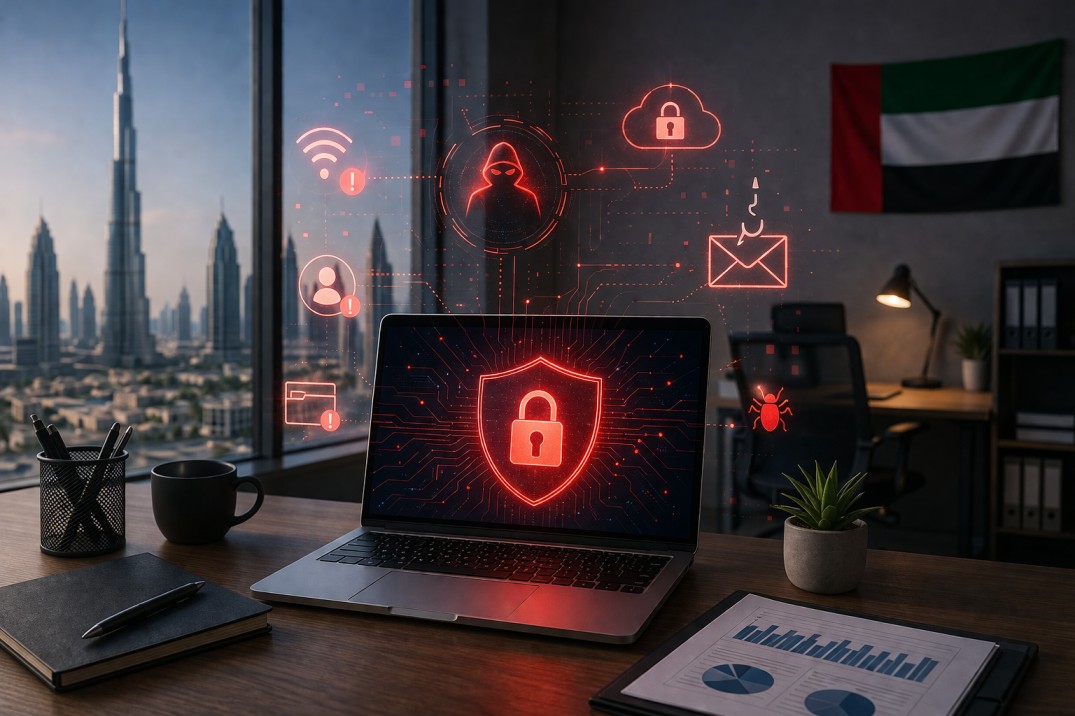
Based on verified 2025-2026 UAE cybersecurity data from CPX, NESA, and UAE Cyber Security Council · Includes PDPL compliance guidance for UAE SMBs
A small business owner in Dubai gets an email that seems to come from their bank. After clicking the link and typing their login information, their business account is compromised within minutes. It is surprisingly common, and the incidents occur more frequently now than ever before.
The United Arab Emirates has turned into the most targeted state concerning cyber crimes in the whole Middle Eastern region. The UAE Cyber Security Council rejects more than 200,000 cyberattacks on a daily basis, its not a typo error; they block over 200,000 every day.
Yet, even with such high levels of security in place, hackers are still making their way through. As always, small and medium businesses have been suffering from the increased frequency of attacks. But not because they represent a greater profit opportunity for the criminals. No, because they are easy to break into. They often run without dedicated IT staff, use outdated software, and lack the security policies that larger companies take for granted.
This guide explains why the risk is growing, what threats are hitting UAE SMBs the hardest, and most importantly what practical steps you can take right now with the hardware and tools already available.
UAE Cybercrime: the numbers you need to know (2025-2026)• The UAE is the 2nd most targeted country in the MENA region for cyberattacks • Average cost of a cyber incident for a UAE business: AED 10.6 million ($2.9 million) • Ransomware attacks grew by 32% in 2024, and are continuing to rise • 83% of UAE CISOs say human error is the #1 security risk • 80% of small businesses globally experienced at least one cyberattack in 2025 • Since early 2025, over 12,000 Wi Fi breaches were recorded in the UAE, 35% of all attacks Sources: CPX State of UAE Cybersecurity Report 2025 · UAE Cyber Security Council |
There is a general misconception in the minds of small enterprises: “We are so small to become a victim of cyber attacks.” But cyber criminals hold the complete opposite opinion; they look forward to hacking into smaller organizations precisely because they are easy targets.
Large firms invest in security experts, expensive firewalls, monitoring systems round the clock, and plans in case of any attack, while small firms lack everything mentioned above. This is what makes them an attractive and cost effective target.
Small businesses experience four times as many confirmed breaches as large organisations when measured per employee a staggering difference that reflects the gap in resources and preparedness between the two groups.
Factor | Why it is increasing your risk |
Rapid digital transformation | UAE businesses are moving fast cloud services, digital payments, online operations. But the security foundations are not keeping pace with the speed of adoption. |
AI powered attacks | In 2026, attackers use AI to generate convincing phishing emails, fake voice messages, and deepfake videos at scale. 41% of cyberattacks on small businesses now involve AI. |
New compliance laws | UAE’s PDPL (Personal Data Protection Law) came into effect in 2026. Non compliance now carries fines up to AED 5 million a direct financial risk on top of the attack risk. |
#1 | Phishing and social engineering attacks | Very High Risk |
The most frequent way that cybercriminals enter the UAE is through phishing attacks. The employee gets an email from their boss, bank, vendor, or government department and follows the link or opens the attachment without thinking twice.
By 2026, the emails are created with AI software and can be almost impossible to differentiate from authentic messages. They include legitimate company names, projects, and language usage. Even educated employees are getting duped by such phishing messages.
The most alarming type of phishing attack today is called Adversary in the Middle (AiTM). It can completely bypass Multi Factor Authentication (MFA) systems since it monitors the user’s session in real time and then takes control of the computer. Microsoft has warned UAE companies about this emerging cybersecurity risk on the Microsoft 365 platform.
What protects you: Business laptops with hardware enforced browser isolation (like HP Wolf Security’s Sure Click Pro) prevent malicious links from infecting the main system even if an employee clicks them. Learn more about business laptops with built in security at Gadgetly UAE.
#2 | Ransomware your data held hostage | Extremely High Risk |
Ransomware represents the most financially destructive form of cyberattack targeting UAE small businesses. The attackers use ransomware to encrypt all your business data, databases, emails and then demand a ransom fee (in cryptocurrency) for access to the data. The number of ransomware attacks increased by 32% in 2024 and new criminal groups keep emerging.
As of 2026, besides encrypting your data, ransomware attackers now steal your data first. Failure to pay means that they will leak your client and financial data to the public domain. You are still liable for leaking the data even if you recover them via backup and therefore subject to additional PDPL charges.
The average ransom demanded by cyber attackers per SMB is in the range of AED 50,000 – AED 500,000 which is unaffordable to the majority of SMBs. Even then, the attackers cannot guarantee complete data restoration.
Prevention: Using a NAS device capable of snapshots and versioning like QNAP or Synology, it enables you to go back to your data prior to encryption without paying ransom. Coupled with a hardware firewall to block ransomware communication, it can shut down the attack in progress.
#3 | Unsecured devices and weak endpoint protection | High Risk |
Every laptop, desktop, server, and smartphone in your business is a potential entry point. Most of them will be using Windows 10 that was no longer getting any security support from Microsoft since October 2025 which means all the newly discovered vulnerabilities will remain permanently exposed on such systems.
Low cost consumer laptops from electronics malls may save money up front but will be lacking critical enterprise grade security elements that are essential for defending against today’s threats: no TPM 2.0, no security at the hardware level, and no tools for remote monitoring and intervention by the IT staff.
Laptops that will keep you safe: Business class laptops are equipped with TPM 2.0, Secure Boot and BIOS level security. Upgrading to a newer version of Windows becomes necessary if your organization is still using Windows 10.
Read our guide on Windows 10 vs Windows 11 for UAE businesses to understand the full risk and the upgrade path.
#4 | Unsecured Wi Fi and network vulnerabilities | High Risk |
Over 12,000 Wi Fi breaches were recorded in the UAE in the first months of 2025 alone, accounting for 35% of all cyberattacks reported. This is a staggering number and it reflects how many UAE offices, cafés, and shared workspaces are running inadequately secured wireless networks.
Attackers set up fake Wi Fi hotspots in business districts, hotels, and co working spaces in Dubai that look legitimate. Employees connect, and the attacker intercepts all traffic login credentials, emails, financial data in real time.
Even in private office networks, a poorly configured Wi Fi router without WPA3 encryption, network segmentation, or a separate guest network creates a wide open attack surface.
What protects you: A business grade Wi Fi router or access point with WPA3 support, VLAN segmentation for guest and staff networks, and automatic firmware updates removes the majority of wireless attack vectors. Read our blog on the best Wi Fi routers for UAE offices for specific recommendations.
#5 | Human error your biggest internal vulnerability | High Risk |
As per the State of UAE Cybersecurity Report by CPX, a vast number of 83% of CISOs from the UAE have highlighted human errors to be the biggest threat to cybersecurity in 2024, ahead of all technical risks.
This includes employees clicking links sent via email or message, having easy passwords, transferring confidential information through unsecured means and inserting unauthorized external storage media. This is certainly not an issue of blame games between employers and employees, but about how attackers target human nature of acting in haste, trusting authorities, feeling inquisitive and trusting others in a professional environment.
An intelligent attack will certainly trick even seasoned experts. In case of UAE SMBs, which employ fewer employees and do not have any designated IT professional who is performing other functions, a click from any one employee may endanger the entire company.
What can protect you from this threat: Proper employee training and policy enforcement along with technology that reduces impact of human mistakes. Hardware based security measures, such as browser isolation and application sandboxing on business laptops, contain damages caused despite the human mistake.
#6 | Ransomware as a Service (RaaS) and supply chain attacks | Growing Fast |
In 2026, one no longer needs to be a hacker in order to commit a ransomware attack. Today, there are criminal organizations offering Ransomware as a Service where one can get their hands on ready to use malware along with templates and assistance. These kinds of subscription services have lowered the bar significantly for anyone who wishes to commit cybercrimes.
Similarly, supply chain attacks pose a big threat. In such attacks, the attackers exploit the connection between you and another business or an entity, using that as a backdoor into your organization without ever targeting you specifically.
Defense against this: Check the list of third party tools that can access your system and limit their privileges through least privilege principle. Set up a hardware firewall for your network and block the communication channel used in any suspicious activity originating from your premises.
Cybersecurity in the UAE is no longer just about protecting your business. It is now a legal requirement.
The Personal Data Protection Law (PDPL) Federal Decree Law No. 45 of 2021 came into full effect in 2026. It requires all UAE businesses that collect or process personal data (customer names, emails, payment information) to implement proper security measures and report breaches within 72 hours.
UAE Regulation | What it means for your small business |
PDPL (Personal Data Protection Law) | You must protect customer data, report breaches within 72 hours, and get consent before collecting personal information. Fines up to AED 5,000,000 for violations. |
Federal Cybercrime Law (Decree Law No. 34/2021) | Criminalises unauthorised access, data theft, and cyber fraud. Also imposes legal obligations on businesses to maintain secure systems. Fines from AED 100,000 to AED 2,000,000. |
NESA Information Assurance Standards | Mandatory for critical infrastructure; increasingly expected by government clients, enterprise buyers, and regulated sector partners. Covers 188 security controls across 5 domains. |
DIFC / ADGM (Free Zone) | Businesses operating in DIFC or ADGM follow GDPR aligned data protection rules stricter than mainland requirements. Non compliance fines reach USD 100,000 per violation. |
PDPL deadline do not wait Full PDPL compliance is required by 1 January 2027, with a one year transition period that started in 2026. Many UAE SMBs are not yet compliant. Start now: audit what personal data you hold, secure your devices, and understand your breach notification obligations. |
The hardware first approach to cybersecurity for UAE SMBs
Software tools like antivirus and passwords are important but they have limits. Modern cyberattacks are designed to bypass software protections. The most reliable defence for an SMB starts with the right hardware.
Here is what every UAE small business should have as a baseline in 2026:
Hardware | What it does | Why it matters for UAE SMBs |
Business grade laptops (TPM 2.0) | Hardware security chip encrypts data and enables secure login. Self healing BIOS on HP EliteBook/ThinkPad protects against firmware attacks. | Consumer laptops lack TPM 2.0 leaving employee data unencrypted and unmanageable remotely. |
Hardware firewall | Monitors all incoming and outgoing network traffic. Blocks ransomware communication, phishing redirects, and suspicious connections in real time. | UAE’s rise in ransomware and phishing attacks makes a firewall non negotiable for any office network. |
NAS with snapshot/versioning | Creates point in time backups of your files. If ransomware encrypts your data, you restore to the previous snapshot without paying a ransom. | Ransomware grew 32% in 2024 in UAE. A NAS with versioning is the most cost effective ransomware recovery tool available. |
Encrypted storage drives | Hardware encrypted SSDs make stolen drives unreadable without authentication. Protects data if a laptop is lost or stolen. | A stolen unencrypted laptop containing customer data is a PDPL breach with fines up to AED 5 million. |
UPS (Uninterruptible Power Supply) | Protects servers and NAS from sudden power cuts, preventing data corruption and hardware damage from voltage spikes. | UAE power fluctuations can cause data loss and hardware failure a UPS is essential for any office with a server or NAS. |
Browse Gadgetly UAE’s full range of business laptops with enterprise security and storage solutions for business data protection. All products include UAE warranty and B2B bulk pricing from 5 units.
You do not need a large IT budget to make meaningful progress. These five steps address the most critical risks immediately:
Upgrade to Windows 11 Pro on all business laptops. Windows 10 is no longer receiving security patches. Every day you remain on it is a day of unpatched exposure. For compatible devices, the upgrade is free.
Enable Multi Factor Authentication (MFA) everywhere. Email, cloud storage, accounting software, banking all of it. MFA prevents 99% of credential based attacks even if passwords are stolen.
Set up a backup with the 3-2-1 rule. Three copies of your data, on two different storage types, with one copy offsite or in the cloud. A NAS device running scheduled snapshots is the simplest way to achieve this for a UAE SMB.
Separate your guest and staff Wi Fi networks. Never let visitors connect to the same network as your business systems. A guest VLAN on a business grade router takes 10 minutes to set up and closes a major attack vector.
Train your team once per quarter. Show employees real examples of phishing emails. Run a simulated phishing exercise. Human error causes 83% of UAE breaches and it is the one risk that training directly reduces.
Learn more about protecting your business with the right hardware:
Best business laptops with enterprise security in UAE HP EliteBook, Lenovo ThinkPad, Dell Latitude with TPM 2.0
Windows 10 vs Windows 11 what UAE businesses need to know the security case for upgrading now
Best Wi Fi routers for UAE offices secure your network at the hardware level
SSD vs HDD for business which is more secure? why hardware encrypted SSDs matter for PDPL compliance
How to choose the right server for your Dubai business building a secure on premise infrastructure
Yes and significantly more so than many owners realise. The UAE is the second most targeted country in the MENA region for cyberattacks. Small businesses are disproportionately targeted because they typically have weaker defences than large corporations. Globally, 80% of small businesses experienced at least one cyberattack in 2025. In the UAE, the combination of rapid digital adoption and limited cybersecurity investment among SMBs makes this risk even more acute.
Phishing is the most common initial attack method employees receive fraudulent emails designed to steal login credentials or deliver malware. Ransomware is the most financially devastating attackers encrypt your business data and demand payment to restore it. In 2026, AI is being used to make phishing emails nearly indistinguishable from genuine communications, making them significantly more dangerous than traditional scams.
The Personal Data Protection Law (PDPL) Federal Decree Law No. 45 of 2021 is the UAE’s equivalent of GDPR. It came into full effect in 2026 and requires all businesses that collect or process personal data (customer names, emails, contact numbers, payment details) to implement appropriate security measures, obtain consent before collecting data, and report any data breaches to the UAE Data Office within 72 hours. Non compliance carries fines of up to AED 5,000,000. Full compliance is required by 1 January 2027.
The average cost of a cyber incident for a UAE business has reached AED 10.6 million ($2.9 million) according to CPX’s State of UAE Cybersecurity Report. For a small business, even a fraction of this cost covering ransom payments, system recovery, legal fees, regulatory fines, and reputational damage can be existential. The cost of prevention (proper business laptops, a hardware firewall, a NAS backup device) is a fraction of the cost of a single successful attack.
NESA compliance is mandatory for critical national infrastructure operators and government entities. For private sector SMBs outside these sectors, it is not currently mandatory but it is increasingly expected by government procurement processes, enterprise clients, and regulated sector partners. If your business handles government data, works with regulated industries, or aspires to win government contracts, NESA compliance is a practical requirement. Many UAE businesses are pursuing it voluntarily as a trust and credibility signal.
Start with three steps that cost very little: (1) Enable MFA on all accounts free and blocks the majority of credential attacks. (2) Upgrade from Windows 10 to Windows 11 free on compatible hardware and closes a major unpatched vulnerability window. (3) Set up a scheduled backup to a NAS device or encrypted external drive provides ransomware recovery without paying attackers. For the hardware layer, business grade laptops at Gadgetly UAE start from AED 2,400 a worthwhile investment compared to the cost of a breach.
Under the PDPL, you are legally required to notify the UAE Data Office within 72 hours of discovering a breach that involves personal data. Depending on the severity, you may also need to notify the affected individuals. Failure to report carries fines, and the breach itself if it results from negligent security practices can result in additional penalties. The Cybercrime Law (Decree Law No. 34/2021) may also apply if the breach involved unauthorised access to systems, with fines ranging from AED 100,000 to AED 2,000,000.
Business grade laptops include security features that consumer laptops do not have: TPM 2.0 chips that encrypt data at the hardware level, Secure Boot that prevents malicious software from loading before Windows starts, and in premium models like the HP EliteBook HP Wolf Security, which includes self healing BIOS, browser isolation, and AI powered malware detection. These hardware enforced protections work even when software defences are bypassed. Browse business laptops at Gadgetly UAE all models include UAE warranty and enterprise security certifications.
ABOUT US
Gadgetly is an IT trading company based in the UAE supplying computer systems, networking products, peripherals, and technology accessories across the region. Through our online platform, customers can source genuine IT products with reliable delivery options and competitive pricing.

Gadgetly ©2026 . All Rights Reserved. TL No – 2306964
Get an instant 10% off on 1st Purchse