Shopping Cart (0)
Close


No products in the cart.
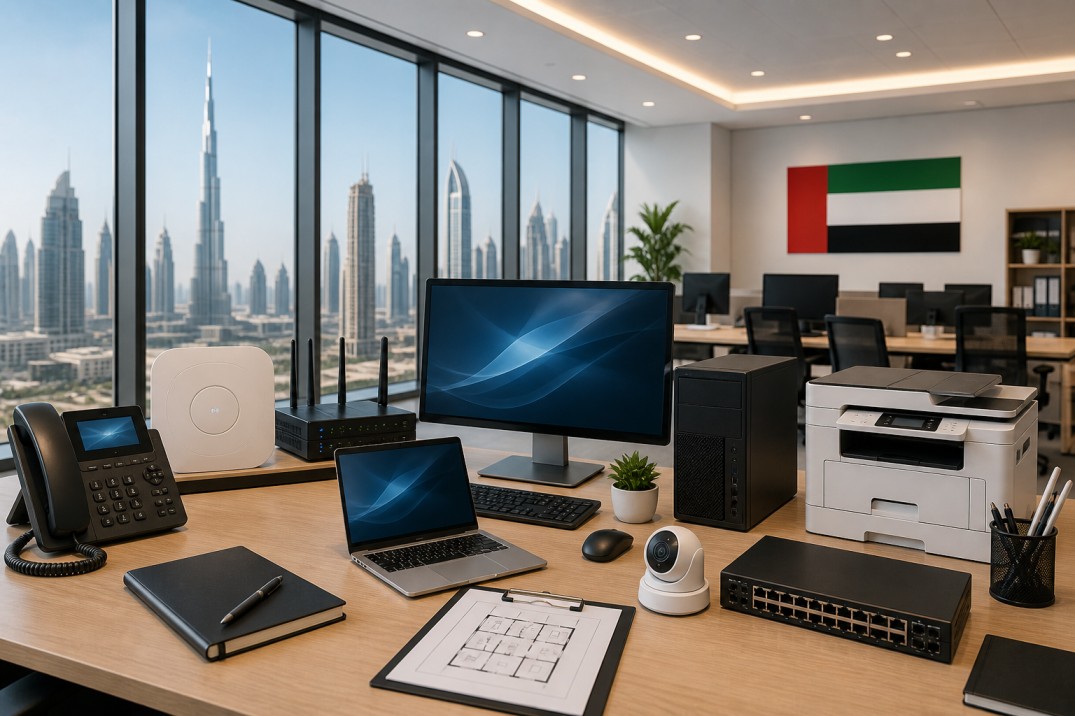
Starting an office in the UAE is thrilling; however, making sure that your technology is sorted right from the beginning is key to success. Whether you’re launching a startup in Dubai, expanding to Abu Dhabi, or relocating to a free zone, your IT infrastructure is the backbone of everything you do.
This guide walks you through exactly what you need, in plain language, so you can set up your office IT without confusion or costly mistakes.
The UAE has one of the most digitally advanced business environments in the world. SMEs account for 94% of the country’s businesses, and most of them depend on reliable technology from the first day of operations.
A slow internet connection, a weak network, or poor hardware choices can lose you clients and slow down your entire team. Getting it right upfront saves money, downtime, and frustration later.
The biggest mistake businesses make is buying equipment before planning. Start by asking:
How many employees will work from this office?
Do you need on site servers, or will cloud storage do?
Will staff work remotely or in a hybrid setup?
What software does your business rely on daily?
By connecting with specialists in IT infrastructure setup, you can develop a detailed and configured plan for your new office IT setup and they can also provide an estimated budget for the move.
Planning even a basic IT layout before spending a dirham will save you significantly in the long run.
In the UAE, your main providers are Etisalat (e&) and du. Both offer fiber optic broadband, which is the recommended choice for any business office.
Why fiber? It’s fast, stable, and handles video calls, cloud applications, and multiple users simultaneously without lagging.
For a team of up to 10 people, a 100–500 Mbps fiber plan is usually sufficient. Larger offices should consider 1 Gbps or above, especially if you’re running VoIP phones or heavy cloud applications.
Also, always have a backup internet line. A dual WAN router allows you to switch between connections automatically if one goes down so your business never stops.
Once you have internet sorted, the next step is building a solid internal network. This includes:
Routers and Switches A business grade router (not the basic one your ISP provides) manages your traffic and keeps things secure. Switches distribute the connection across your office devices.
Wi Fi Access Points Don’t rely on a single router for Wi Fi coverage. For a medium sized office, deploy at least 2–3 access points strategically placed to ensure every corner has strong signal.
Structured Cabling Structured cabling complies with industry norms, delivering a trustworthy and scalable foundation for your IT structure.
Cat6 ethernet cables are the standard for UAE offices in 2025. They support speeds up to 10 Gbps and are future proof for most business needs.
Here’s a practical breakdown of what most UAE office setups need:
Computers and Laptops Decide whether your team needs desktops (better performance, lower cost) or laptops (flexibility for hybrid work). For most UAE businesses, a mix of both works well.
Printers and Scanners A multifunction printer that handles printing, scanning, and copying is standard. Look for models with wireless printing and support for Arabic fonts essential for UAE businesses.
Monitors and Peripherals Dual monitors improve productivity significantly for roles involving data, design, or finance. Invest in quality keyboards, mice, and headsets, especially if staff are on calls regularly.
UPS (Uninterruptible Power Supply) Power fluctuations can damage equipment and cause data loss. A UPS keeps your machines running safely during outages and protects hardware from voltage spikes.
You can browse a wide range of business ready laptops, monitors, and networking accessories at GadgetlyUAE to find the right fit for your office budget and size.
Smaller offices in the UAE can often skip expensive on site servers entirely and go fully cloud based with Google Workspace or Microsoft 365. These platforms give you:
Business email with your domain
Cloud storage (Drive or OneDrive)
Video conferencing (Meet or Teams)
Collaborative documents
For larger businesses or those handling sensitive data (finance, healthcare, legal), an on site NAS (Network Attached Storage) or a hybrid cloud server setup gives more control.
Server installation services help select and install the most appropriate servers for your business requirements which may include incorporating cloud solutions to improve adaptability and scalability.
Cybersecurity is not optional in the UAE. The country has strict data protection laws, and businesses are increasingly targeted by phishing, ransomware, and data theft.
Here’s your essential UAE office cybersecurity checklist:
Firewall Install a hardware firewall at the network level
Antivirus Software Deploy on every machine in the office
VPN Essential if staff work remotely or access sensitive systems
Strong Password Policy Use a password manager and enable two factor authentication
Regular Backups Back up data daily, both locally and to the cloud
Employee Training Most breaches happen because of human error, not software failure
A trustworthy IT system ensures your team can work in a secure zone, especially if you have work from home, remote work, or a hybrid work module in your plan.
Your team needs to communicate efficiently from day one. Here’s what most UAE offices set up:
VoIP Phones Internet based phone systems cost far less than traditional lines and offer features like call recording, extensions, and international calling
Messaging Platforms Microsoft Teams, Slack, or WhatsApp Business for internal communication
Video Conferencing Zoom or Google Meet for client calls and remote meetings
Business Email Always use a domain based email ([email protected]) it looks professional and builds trust
Working with a trusted IT solutions provider in UAE can help select the best licensed software based on your budget.
Using pirated software is not only illegal in the UAE it also exposes your business to massive security risks. Common licensed tools UAE businesses use include:
Microsoft 365 Word, Excel, Teams, Outlook
Zoho or QuickBooks Accounting and CRM
Adobe Creative Cloud For design focused businesses
Industry specific software ERP, POS, or project management tools
Your IT infrastructure must be scalable and expandable to accommodate the growth of your organization. When purchasing switches, routers, and cloud services, make sure you only purchase scalable equipment.
Buy switches that come with additional ports, consider upgrading cloud services easily, and use modular servers in case you prefer going on premises.
Having a proper IT infrastructure will save you lots of money in the future.
Even with a solid setup, things break. Having a reliable IT support partner in the UAE means:
Quick response in case something goes wrong
Maintenance and upgrades
Onboarding assistance for new employees
An IT expert who understands your infrastructure well
By working with IT support partners, you can save a lot of time, but most importantly, prevent potential issues that were experienced by a marketing startup in Business Bay who worked with a managed services provider and set up their office in less than 2 weeks.
Whichever route you choose, be sure not to go at it alone.
Here’s a quick reference for a 5-10 person office:
Item | Recommended Spec |
Router | Business grade dual WAN (TP Link ER605 or similar) |
Switch | 24 port Gigabit managed switch |
Wi Fi Access Points | Ubiquiti UniFi or TP Link EAP series |
Computers | Core i5/Ryzen 5, 16GB RAM, SSD |
Printer | HP LaserJet Pro multifunction |
UPS | APC Back UPS 1500VA |
NAS (optional) | Synology DS923+ |
Internet Speed | Minimum 200 Mbps fiber (1 Gbps recommended) |
For the best deals on these and similar products, check out the latest offers at GadgetlyUAE your go to destination for business tech in the UAE.
For a team of up to 10 people doing standard tasks (emails, video calls, cloud apps), a 100-300 Mbps fiber connection works well. For larger teams or data heavy work, go for 500 Mbps or 1 Gbps.
For startups and small businesses, cloud storage (Google Drive or OneDrive) is more cost effective and easier to manage. Larger businesses with compliance or data control needs should consider hybrid setups with both cloud and local servers.
At minimum: a hardware firewall, antivirus on all devices, VPN for remote access, two factor authentication on all accounts, and regular cloud backups. UAE data protection laws make security a legal requirement, not just a best practice.
Basic setups can be done in house, but for structured cabling, server installation, or network design, it’s worth hiring a professional. Mistakes in network setup can cost more to fix than the initial installation.
Microsoft 365 (most popular), Google Workspace, Zoho CRM, QuickBooks for accounting, and Slack or Teams for communication. Always use licensed versions to stay compliant with UAE regulations.
A basic 5-10 person office setup including hardware, networking, and software typically costs between AED 15,000 to AED 50,000 depending on quality and scale. Cloud first setups are on the lower end; server based setups are higher.
Free zone infrastructure is generally well developed, with IT support services including telephone and high speed internet connections. Free zone authorities also provide different support services and facilities to help investors and entrepreneurs establish their businesses. However, internal office IT setup computers, internal networks, security is still your responsibility.
Getting your company IT set up in the UAE does not have to be such a daunting task. Simply take your time and walk yourself through every single component, starting with the internet and networking, followed by the actual hardware, cybersecurity, and finally the necessary support.
Begin by assessing your current requirements, and plan ahead for your future in two years. In the process, ensure that you do not make compromises in terms of cybersecurity and back-up systems.
If you are now in the market for your office technology equipment, then look no further than GadgetlyUAE.
ABOUT US
Gadgetly is an IT trading company based in the UAE supplying computer systems, networking products, peripherals, and technology accessories across the region. Through our online platform, customers can source genuine IT products with reliable delivery options and competitive pricing.

Gadgetly ©2026 . All Rights Reserved. TL No – 2306964
Get an instant 10% off on 1st Purchse